
"Nearly famous since 2001"
 |
 |
 |
 |
 |
 |
 |
|
 |  |
 |
 |
 |
 |
||
 |

Select a Craft





Paper Casting Recipe & Directions
Below are the directions we use for making paper castings.
Mixing the paper pulp 1. Fill a blender with toilet paper of choice. 2. Fill blender with water. 3. Blend for about 45 seconds. (Now its pulp.) 4. Pour some pulp into a strainer over sink or bowl. 5. Plop pulp onto mold and place on a towel*. 6. Place a piece of toilet paper or a tissue over pulp. 7. Couch out some water with soft cloth and towel over it. 8. Make a deckled edge by going around mold, ripping off extra pulp and toilet paper. 9. Couch out as much water as possible with cloth and towel. 10. Gently remove the casting from mold. Drying 1. Allow castings and paper to air dry on counter. 2. When cast is almost dry place a soft cloth and a book on top of it for a while**. 3. Take book off and allow to dry some more. 4. Repeat process a few times. This is like baby-sitting but it prevents the casting from curling*. Before using your mold for paper casting I would suggest that you use a pan release on it first (something without a strong flavor). Then gently wash the mold with a mild soap, pat some water out and get to paper casting. 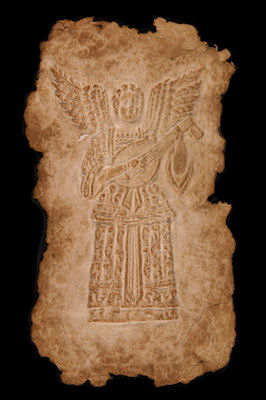 Large angel - tea stained paper casting 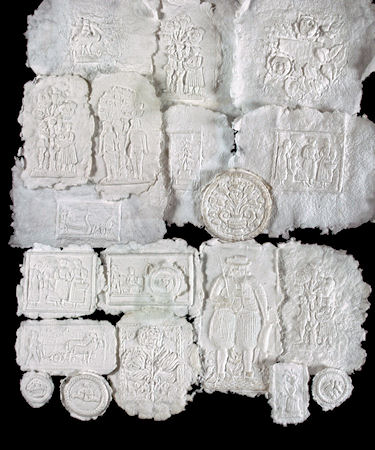 Paper castings collection |
Notes *- I usually have my mold on a towel or two. Water will be spilling over the mold.
In couching water from the mold, I use two washcloths- press, wring, press, wring. Be sure to press well over the details of the mold. **- The book may or may not be necessary. Here lately I have been putting something with a little weight around the edges of the paper casting. I will also put my fresh paper casting on newspaper to help wick the moisture away. I change the newspaper about every 8-12 hours but some suggest not to do this. There is an ever so slight chance that the paper casting will bond with the newspaper. I have not found this to be the case. Try mixing in a bit of liquid starch with the pulp after blending. This should give you a much stiffer paper casting. I'm not sure of the long term effects yet. Adding color to you casting will add another dimension to your artwork. Experiment and have fun! 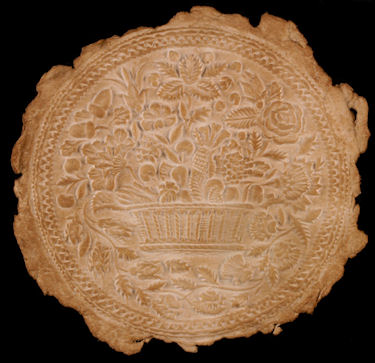 Fall harvest - tea stained paper casting 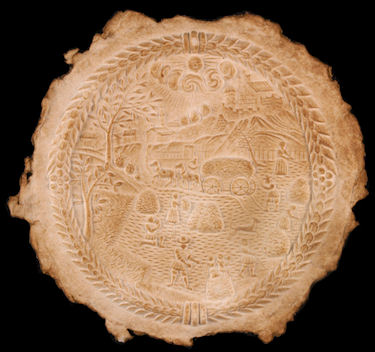 Large harvest - tea stained paper casting |
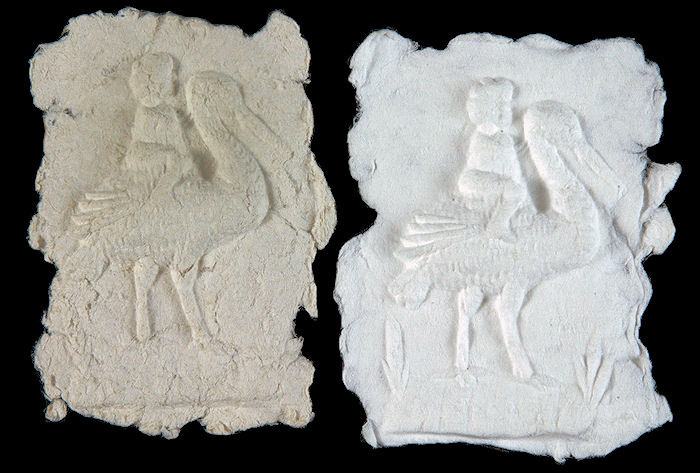
My first paper castings
Contact: Ken Hamilton
Email: ken@thespringerlebaker.com
Phone: 828-380-0578
Phone: 828-380-0578
Web site prepared by
 | Copyright: 2007 Ken Hamilton, TheSpringerleBaker.com |